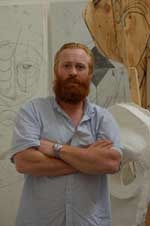
It is not always that I remember when I first saw an artist’s work but in the case of Thomas I do remember. It was in 2006 at LA Artists from the Rubell Family Collection one of the Rubell Collection openings. It was Art Basel Miami week when arted out from the fair I came into a room composed of several large menacing, seemingly primitive figures. Coarse plaster figures, the faces were roughly drawn smudgy charcoal masks recalling the primitive faces from Picasso’s Demoiselles d”Avignon their wrenched apart. My reaction walking among them was of encroaching in someone else’s territory. It was a place seemingly dangerous to enter but somehow worthy of exploration.
I was impressed by the work enough to seek Houseago out when I next went to Los Angeles. Gary Garrell, then at the Hammer, sent me to his studio in East LA and I spent a few hours with the red haired guy born in 1972 in Leeds who arrived in LA via studying in Holland . Lured by his friendship with fellow artist to this part of East LA which the Standard where I was staying warned me from entering.
I liked his red haired palpable high- energy. He told me he was married to an Italian woman and loved spending time in Florence studying Michelangelo. How much his work related to the old masters and how much he owed to their influence. There is also palpably a thread of European modernism in the work from Rodin and Picasso through to England’s own Jacob Epstein. He was impressive, fierce and committed. At the time there was little in the studio as he told me he was between bouts of work. He worked in two small rooms, building the plaster works on the floor face down so when he broke them loose he really did not always know what they would look like. There was an element of risk that he liked. He admitted that there was little work as recently he had sold a group of works to a hedge fund collector, Steven Cohen. He was cleaning out and thinking about the next group.
After that my only contact with him was seeing his work at art fairs around the world. His galleries grew in numbers and it was only when I stumbled on a large bronze on a Belguim gallery stand at Basel last year that I began to begin to question the quantity of his output. ‘Why bronze?’, I asked pointing at a rather glunky looking seated figure – ‘collectors wanted them for outside so they needed to be in different materials’. Oops I thought. Here is an artist who was all about transient materials, often found he had told me in skips in LA that he lugged back to the studio to await their moment . He had related when a collector returned a work to be repaired as a cigarette pack had fallen out of it. ‘Yes, I used whatever materials to make the plaster with that was handy. I just restuffed it into the sculpture’.
Now Thomas has a show at Oxford MOMA. I went to see it on a cold winter’s day. The day before I had lunch with a young artist who said dismissively , ‘oh Houseago! You see them all over art fairs in the way you used to see Oursler’s everywhere or Reyles.
The first omens were not good. The main large room has one early work, the only early work in the show. Crouching Figure from 1998. There is something deeply wrong about this work but it is this wrongness that is right. Ominous, awkward, hands cut off at the wrists, getting close to it one feels that you are crowding a primeval form, pulsating with raw energy.
Nearby there is a pile of clay, transformed into gilded bronze, looking strange and not very interesting. Standing with Michael Stanley, the director points to the Clay Mountain 1 (Sun) nearby, signs of an artist imprinted clearly. This is like a work I had seen in LA. Mounded on the floor, full of marks and incident and experimentation and alive. Nearby a work, Biggest Spoon-outdoors (2010) lies on the floor, inert and boring. So it is a big spoon, so what? This work is worlds apart from Crouching Figure nearby. An artist intent on making works that can adorn collectors gardens.
It is not all bad here. An impressive recent work, Baby stands alone in a nearby gallery. Split apart showing the different methods of work that Hoseago has mastered. Twirls of clay around the arms, braced with raw metal, split apart. Drawn on. Worked on. Exciting.
We go to lunch at the Ashmoleon, guarding the stairs a Houseago sentinel, white bronze masquerading aa plaster its feet on the base awful awkward snowshoes to balance the stonking bronze weight. Ugh. The jury is out - Thomas.
Sunday, 19 December 2010
Wednesday, 15 December 2010
Artissima
Writing about another art fair could be boring- but this is Turin’s Artissima (17) so there is a difference. The difference is that this is a fair that is financially supported by the city of Turin, a concept that would be foreign for London and Frieze or Paris and the FIAC. The depth of support is reflected in the subsidized purchase of works from the fair for a value up to 350,000 euros, the works chosen destined for the collections of the two major museums in Turin, Castello di Rivoli and GAM.
![]() |
| Francesco Manacorda |
Francesco Manacorda is the new director for Artissima having taken over the role from Andrea Bellini, now the co-director with Beatrice Merz of the Castello di Rivoli. Francesco was born in Turin and studied both in Turin and London where he later settled as a freelance curator before becoming the curator for the Barbican. While there he was responsible for the "Martian Museum of Terrestrial Art" (co-curated with Lydia Yee, 2008) a highly regarded show that reflects his intelligent and innovative thought processes. Why Artissima? He says that he wanted ‘freedom from institutions.’
Francesco, like many other leading contemporary curators has been studying the ‘crossover of the arts,’ in particular literature, philosophy, science and dance. In order to house the now de rigeur cultural programme he commissioned the German cooperative RAUMLABOR to design a section of the fair which he hoped would provoke and entice a new audience to the fair. Words like Dance, Literature and Poetry now figure in all visual arts cultural programmes, and this one is no different.
![]() | |
| Raumlabor's temporary sculptures |
I like Francesco enormously and would like to report that this was an enormous success but feel that the programme is a ‘work in progress’ with many good lessons learnt. Artissima has moved into a new hall this year with its new director. It was formerly an ice skating hall for the winter Olympics and has that strangely slick, slightly corporate look, very different from the slightly shabby hall that was used the year before. It is noticeably more spacious with more room between the aisles to meander in but which also has the down side of seeming more anonymous and less intimate.
To this slightly antiseptic environment the German collaborative RAUMLABOR have introduced recycled seediness into the aptly named, House of Contamination taking here the form of a large temporary structure. Iron scaffolding which creaks and strains surrounds bails of recycled paper and cloth heaps of old clothes, emitting a slightly sour smell. Here on old washing machines and fridges the literary programme is unrolled, while in a temporary theatre a series of dance troops recreate performances.
Manacorda had a hard act to follow. Last year, Andrea Bellini rolled out a performance marathon which I partook of fully. So fully, in fact, that by the end I was dazed and confused, but also exhilarated and turned on by the variety and intensity of the events performed in the various unique theatres of Turin. I will never forget the GELITIN performance in the stunning Teatro Regio designed by Turinese designer extraordinaire Carlo Mollino, culminating in not one not two but eleven golden showers followed in the same location the next evening by Michelangelo Pistoletto’s recreation of his famous 1960s work, Anno Uno—Terzo Paradiso. Incorporating many of the same performers or in some cases their children or even their grandchildren, the carefully choreographed event was a complete contrast to the anarchic antics of the evening before. Add to this, Jim Shaw’s, band, ‘A Tone, Meant for Your Sins, a homage to proto-punk group Destroy All Monsters that Shaw had formed along with fellow artists Mike Kelley and Niagara, and filmmaker Cary Loren, Matt Mullican, self hypnotic state and Cao Fei’s avatar live masturbating performers and you get some idea of what I saw.
Francesco’s programme included a recreation of Oskar Schlemmer-4 Reconstructions by Debra MacCall. It was nice but taking place next to the bazaar atmosphere of an artfair, no matter how polite a fair it is, it was hard to get into the mood.
![]() |
| Jonathan Safran Foer's Tree of Codes |
Later-perched on an old washing machine made it difficult to fully appreciate the beauty of New York writer, Jonathan Safran Foer’s newest work, Tree of Codes. This slim tome illustrates Francesco’s desire for cross over, here Safran Foer transforms his favorite work of fiction, Bruno Schulz’s “Street of Crocodiles, into something more sculptural than literary. Jonathan confirms that his is not a new idea,’I took my favorite book, and by removing words carved out a new story. It was hardly an original idea: it’s a technique that has, in different ways, been practiced for as long as there has been writing — perhaps most brilliantly by Tom Phillips in his magnum opus, “A Humument.” But I was more interested in subtracting than adding, and also in creating a book with a three-dimensional life’.
![]() |
| John Stezaker |
Wandering back into the gracious wide aisles of the fair there was lots however to cheer about. Back to the Future, produced mini one-man shows that included some real winners, some living, some dead. I particularly liked the Lisson stand of John Stezaker displaying his sculptural books - great or at least important imposing books – including Collected British Law, enveloped by thick tarry gloop, books as you have never seen them before.
![]() | |
| Franco Guerzoni |
Franco Guerzoni an artist from Modena who I had never come across before. I am transfixed by the work, decorative, in the same way as Christo yet none the worse for it. Here are the insides of buildings, revealed by demolition, their archaeology picked out in geometric squares of paint. Books appear too, in groups of photographs with collaged elements embedded into the surface. In one a series of razor blades, in another the surface is filled with folded sheets of decorative paper.
There are discoveries to be made in the main fair as well. Strong showings by Italian galleries is to be expected, and I like the stand by Gonzalez y Gonzalez, from Santiago, Chile, spearheaded by Jota Castro whose sculpture work here, Go Kids Go, consists of festive helium balloons as seen at children’s parties and shops around Latin America, attached to bullets, both catch the eye and exercise the mind. Castro comes originally from Chile but is currently based in Brussels. He runs the gallery as almost an artists cooperative, reflecting the need for an outlet for contemporary art in Chile. He says many of the artists on the stand have international representation but nowhere to show in their home.
Balloons aplenty in the Castello di Rivoli with their Philippe Parreno installation, Snow Dancing-Speech Bubbles. The top floor of the castello is filled with shimmering silver balloons in the shape of sound bubbles. I talk to Philippe who tells me that he does not know how long the work will last. Helium is unpredictable and does funny things in different locations. The speech bubble shape is not a new one for him, but silver is, and when I point out the Warhol connection he shoots back that it only came to him once the balloons were in place. The balloons come out of the idea of procession and events, something that Parreno has been thinking about recently. As a multi practitioner, Parreno makes films, drawings and performances, the vestigial balloons of an event, now past makes sense. And they are pretty as they nestle in the rafters.
![]() | |
| Phillipe Parreno |
The lower floors of the castle have been reinstalled, highlighting the depth and strength of the Castello’s permanent collection. Here is displayed the work of Massimo Grimaldi who presents his 10.000 euros. winning piece for the 2009 Fellowship for Young Italian Artists. The work, Emergency’s Paediatric Centre in Goderich is explained to me by curator Marcella Beccaria of the Castello di Rivoli. It is not the images of the hospital displayed here that is the work but the act of applying for the prize. The cash award does not go in this case to Massimo Grimaldi the winner, but as per his instructions directly to the NGO, Emergency which uses the proceeds to build much needed hospitals in Africa. Massimo has in the past raised some 750,000 euros this way and Emergency has build a hospital with the money in the Sudan. I meet the artist and ask him where he has studied, and then answer the question before he can answer, Alberto Gerruti, the visionary teacher from Breara in Milan. He looks startled at my prophecy but then I explain my reasoning. Gerruti is an enabler, not an enforcing teacher and it is reflected in the work of his illustrious pupils, some now in the permanent collection including Paola Pivi and Lara Favoretta. Massimo is an interesting artist, bucking the market strangle hold on much contemporary art.
I love this museum, it has both a wonderful building, view and permanent collection, and even when I don’t buy into their temporary shows totally, the current show, the first under the leadership of Bellini and Merz, by young British Curator, Adam Carr Exhibition, Exhibition is not my favorite, there are some great works in it, including perhaps not surprisingly a strong show of Arte Povera verterans, Turinese artist, Giulio Paolini, Michelangelo Pistoletto and Giuseppe Penone. Paolini’s work, incorporates his first painting, ‘geometric drawing’ (1960) and one he made exactly 50 years later installed at either end of the super-size long room.
Penone displays ‘Being River 6’d (1998) which at first seems to be merely two similar stones. In fact, Penone found them in two different locations and carved the second to appear to be identical to the first. A conceptual and rigorous idea which leads to a case of spot the difference.
Pistoletto shows two photographic works, the conference, (1975) in which the viewer becomes the viewed and a floor work, Five Wells and interactive work in which the viewer is mirrored in the work. Creating a situation where it is impossible to not see oneself while viewing the work.
Not to be outdone there is work by a younger generation which captures the imagination including a double incarnation of Tino Sehgal a work from 2000 and like Paolini his first work provocatively entitled, Instead of allowing some things to rise up to your face dancing bruce and dan and other things. And although a singular work, Seghal uniquely allowed it here to be presented by two interpreters performing as per Seghal’s instructions the movements of Bruce Nauman’s ‘Wall Positions’ (1968) and Dan Graham’s ‘Roll’, (1970). It is powerful stuff, the integration of live performance into the gallery space.
Not to be intimidated by the Castello di Rivoli, local international art world player Patrizia Sandretto re Rebaudengo has established her foundation in a beautiful building designed by Calude Silvestrin Patrizia hosts shows bolstered by her impressive international collection but also embraces other foundations working with contemporary art. This time the focus is on young Russian artists, brought together by Francesco Bonami and ??? working with a new Russian foundation, the
The other fantastic thing about Artissima is that it is in Turin, a city so full of beautiful architecture, food and drink that it is not a penance to be there. For the contemporary art cultural tourist there is not only the Castello di Rivoli and GAM but also Fondazione Sandretto Re Rebaudengo run by the perpetually glamerous Patrizia Re Rebedaungo.
I get stuck into Piedmoentese wines the moment I get there, one of my favorites is nebbiolo but there is also a case for Barbera d’asti, and the more revered barberesco. My personal favorite a slightly sparkling red, Bonado. Yum yum yum
Thursday, 2 December 2010
Bruce Nauman for Beginners
![]() |
| Bruce Nauman, For Beginners |
Angela Westwater and Gian Enzo Sperone’s new space may not be to everyone’s taste but there is no questioning the ambition that fuels it. Now the question is whether artists will be able to impose themselves on what could be an overpowering space? In the current exhibition by Bruce Nauman , ‘For Children/For Beginners’ Nauman has chosen to deal with the double height space with one deceptively simple video, of hands- his of course- every hang nail clearly visible from the mezzanine viewing space. The sound track is Nauman reciting the combinations of possible finger movements , providing the conceptual rules for the piece.
Over the years of Nauman viewing we have been almost Pavlov trained to recognize the artist’s body. Whether pressed up against a wall, muttering, pacing or rolling we have become acclimatized but the scale here is awesome and the king sized hands compulsively moving capture our gaze.
![]() |
| Bruce Nauman, For Beginners (Instructed Piano) |
This is my first time in the finished space- I had seen it during construction- and I am keen to sample the moving room, the very expensive Norman Foster solution to adding space to a narrow problematic site. Health and safety dictates an operator travels with you and Nauman has made the experience as uncomfortable as possible for repetitive viewing – or I should say listening- as the piece, ‘For Beginners-(Instructed Piano); is a sound piece of ear aching jangliness. There are also some bouncy and twirling stools to sit on as we ascend and descend at agonizing slowness. The sounds are performed by a pianist following the same spoken instructions as the video work by moving the appropriate finger to play a note, but we, the viewer. do not get the sound of Nauman’s voice but only the jangling and discordant notes. To add to our discomfort the speakers are hidden in the walls creating a room with sound that appears to be coming from nowhere -but these are not the sounds of skill but of torture.
Upstairs, another sound work, of Nauman's voice recorded repeatedly saying the words 'for children'. Again here are the sounds of nightmares not sweetness.
![]() |
| Bruce Nauman For Beginners |
![]() |
| Bruce Nauman on his ranch, photograph Bart Eberly |
Monday, 8 November 2010
More Massimo Bartolini
Wandering around the Turin Art Fair, Artissima and on Galleria Massimo de Carlo's I stand in front of one of Massimo Bartolini's beautiful paintings called Dew that I had seen in the studio in Cecina. I say to the affable dealer that I had heard that he used a form of oil to make the work look as if it was wet with morning dew and that it stayed wet looking forever. It is Massimo who gently corrects me about the oil saying oh no it dries but the collector gets instructions on how to spritz it again. Modern art is high maintenance. Often involving fresh fruit or vegetables of bread or chocolate or or or or or or.
Take it on only if you are prepared to do it!
Tuesday, 26 October 2010
Sylvia Sleigh, a graceful painter
I went to see Sylvia Sleigh recently in New York. I republish the following article I posted.
Sylvia Sleigh is in her 92nd year and still looking and sounding well. I meet her at her studio in a brownstone on West 20th where she has lived for over 40 years.
With her thick long hair and make up, it is hard to accept her age except for her decreasing height and tendency to tire easily. We settle on a large sofa in the back of the gracious living room, surrounded by the paintings, many of them male nudes that remind you of how hard it is sometimes, to be a woman artist.
I was reminded of Sleigh's work recently in Turps Bananas, a magazine produced by London artist Marcus Harvey, which focuses on artists writing about other artists. Ellen Altfest, an artist whose work I have long admired, is a fan of Sylvia Sleigh's - not surprising when you look at Sleighs works of men, often unclothed, and lovingly and meticulously observed.
Sleigh was married to British critic Lawrence Alloway and left England with him in 1961 for America. She herself had trained at the Brighton College of Art, long before it became a university.
Sleigh painted Alloway well over 60 times, she tells me. When people questioned whether he liked her work, she would say simply - "he must have as he let me paint him again and again." She attributes her lack of recognition to the fact that she was a woman who chose to paint male nudes, something that is still faintly controversial today.
Her muse, Paul Rosano, a large man with an afro hair style was a musician who was not good at getting himself out there. He was one of her favorite sitters and she seems to have mourned his moving out of the city in search of cheaper housing.
It is also easy to lump Sleigh's work with the work of Philip Pearlstein and Alice Neel, but there are palpable differences here. Pearlstein's obsessive replications of the body are meticulous depictions of flesh in a way that differs greatly from the more romantic depictions of Sleigh. Neel's works, often almost caricature like, are also far distant from this vision.
Sleigh's most ambitious works to date, "Invitation to a Voyage" are a group of fourteen panels which together form a 70 foot long work depicting a picnic. The place, an embankment overlooking the island in the Hudson on which eccentric millionaire Frank Bannerman built his castle to house the excess of his military armaments business. Sleigh, like many of us, first saw this strange place from the windows of an Amtrak Train and arranged a picnic on the cutting overlooking it. She invited her friends and in a particularly poignant scene we see her being helped up by a dashing Alloway. Towards the end of the work, the landscape fades into a quasi abstraction, un-peopled and alone - perhaps an allusion to Alloway's death.
The series, named after a work by Watteau, took her an amazing 22 years to finish. I am a sloth, she says but also she admits that she did not paint for ages after Alloway's death. She looks sad when I say you were mourning. In contrast to this melancholy mood the works are washed with flat sunshine these works now in the Hudson Museum in Yonkers, a place I must make a pilgrimage to someday.
Sleigh is not always good - in fact - she could be down right bad and that is what makes the work so interesting.
Monday, 25 October 2010
Massimo Bartolini by the seaside
I spend a quiet weekend in Pietrasanta and Forte dei Marme staring at the sea and on Monday set out for Cecina, a seaside town up the coast from Livorno. I am supposed to meet the artist Massimo Bartolini in a bar called, I hope symbolically, La Dolce Vita and arrive in a larger town than I was expecting. Many bars but none with that name and I am almost about to give up and phone Massimo when I spy a pregnant woman waiting by the side of the road. She says in Italian and sign language that she can’t give me directions but as it is near the hospital where she is going for her check up- and can she get in?- and before I know it she is in the car and leading the way through tortuous roundabouts .
I had met Massimo in London and then fell in love with a work by him in Basel last May. It was called organ and was a work which had a formal structure, a large construction of building scaffolding, the twist was that it was being played, like an old fashioned music box. The lugubrious notes filled the large hall of art statements – permeating the mood of the happy art buyers.
When I phone Massimo to tell him I have arrived bang on time and in the right place - he has the grace to be surprised and grateful. He says he chooses to live here as few people venture to find him and we travel up a road to an industrial estate where he has had his studio for nine years.
That is another fact of life- studios are no longer glam turret rooms or usually not- there are a few of those but often in the least glam parts of town. Often they are metal sheds close to manufacturing works and with few amenities near by.
There is little art to see her as Massimo gets his work fabricated elsewhere but there are a recent series of paintings he has been working on which are as many Italian works obsessed with materiality- in this case a special paint that changes colours as you walk around and are opalescent and seemingly effortless. He then coats them with oil which spots up like dew. It all sounds prosaic – you have to see it to get the full effect.
We settle down to talk and within minutes are tussling about the definition of originality and coming out of other artists. I quote my favorite John Baldessari line – ‘all art comes from art’ and Massimo agrees but says he personally prefers to find out that his work owes something to other people after he has made the art not before.
We share many likes, in particular Francis Alys, Cildo Merieles and Felix Gonzales Torres as well as Gordon Matta Clark but he admits that often they are badly presented. He points out to me how Joseph Beuys is often shown on huge plinths that destroy the works intent.
We talk about the Felix Gonzalez Torres sculpture in front of the pavilion in Venice- and how wrong it was. Felix would never have done that piece in white marble – it was not his material – it would have been shiny turquoise plastic surely. We are turning him into a different artist.
We have a really good laugh about various artists before homing into an intense conversation about John Cage.
Recently I have come to believe that Cage is the most important artist – if you define important by how influential an artist is on other artist. Massimo pulls out a CD of Cage’s compositions to prove this is certainly true in his case. He tells me that the sound I heard in Basel was a Cage composition and related the story of the work he did at the beginning of his career to was also set to another Cage work, Music for Marcel Duchamp. It was about an angel who takes her wings off to take a bath and the devil removes them and holds them as ransom saying she will have to dance to get them back. Just the idea of this piece makes me ache to see it.
Off to the most delicious lunch in a bar like osteria near his studio. Riso de mare- yum yum yum yum yum yum and squid but I wish I had chosen cake and all too soon it is time to go whizzing back up the motorway to Pietrasanta to see and go to the airport and and and and and .
Friday, 15 October 2010
Kiki Smith
![]() |
| Elie Nadelman in MoMA garden |
I am in Italy to interview legendary artist Kiki Smith. She is late arriving and we skip the niceties and we start to talk. Today her long curly grey hair is freely flowing and she is dressed in somber tones of gray and black but her skin has the signature tattoos in turquoise that indicate this is no middle aged middle class woman. I have a long and strange history of Kiki. Over 20 years before I had assigned a review to a self-proclaimed misogynist writer when I was the editor of Modern Painters. He had reviewed her show at Pace Gallery with such viciousness that I had received a call banning forever all my writers from entering Pace or ever being offered help. Time had moved on and I was with a friend painter Sam Messer who asked me out to a dinner with ‘friends’. Much to my horror, his friends consisted of Kiki and her than partner. I sat there hoping to be incognito for much of the dinner until she leaned forward and said in her strangely girlish voice ‘ I know who you are and I forgive you’. I have never formally spoken to her since but seen her at private views and waved to her. Over the years I have thought back to that review and realised how horrible it was and how painful it must have been. Written from the perspective that it is behaviour that should be assessed in artists and that there are givens in the right material to use as well as the given that there has never been a great woman artist I sit embarrassed even in thought.
![]() |
| Kiki in Colle di Val d'Elsa |
When she arrives I say hello and remind her of our history, She is very late and before we even really begin to talk we are whisked off, descending from the hill town on the corkscrew roads and Kiki says I will make you an amulet to Mario and you to she say to me in the backseat, glad I am not in the front. The presentation is outdoors in front of the converted arches that contain her styilised girls as she calls them. Relating clearly to Pre Rennaisance idols and as she tells me to Elie Nadelman, an artist I had not heard of since I played near his large work in the MoMA sculpture garden as a child.
We end up sitting in a beautiful converted theatre watching the documentary made about her and her work a few years ago. Kiki admits she can’t stand watching herself but there is no option so we settle down to an hour of Kiki. Watching her relentlessly working and thinking gives an insight into how the brain of an artist works. I am touched by her endless repetitive model making and drawing and also her determination to make things right, this line is too sharp, that colour is too pink, move the silver girl on the bed, look at the embroidery and that moment of epiphany where she stands by a clothes line in Venice, fingering a beautiful table cloth saying that I want to make prints with this material. It is materials that obviously attract her and it is clear that the materials of this quilt will appear at some later date.
There are also a series of flower drawings that look anything but pretty. She says in the same tone, ‘I made this from blood, I went to the doctor and had it drawn’ and does not seem to realise the painful visions that this immediately recalls.
It is now pissing with rain and I hitch a ride back into town and go to bed with cold pizza and a film. I cannot go to dinner and then walk home through this downpour. I arrive at 9 am in the square near the gallery and already the tourists are pouring into the town. I spy Kiki sitting at a table with a bottle of black nail polish doing touch ups. We settle down to our chat and then all too soon she is off and there is that surreal moment of spying one of the most important Chinese artists in the world, Cai Guo Qiang in town and then it is all onwards.
Lunch is in Bel Soggiorno with a view to die for. It is a buffet of deliciousness and in my present state I want to scoop some up for later but leave it all behind. Sob gulp. There is risotto which is so delicious I want to marry it.
Subscribe to:
Posts (Atom)